Proximal Hamstring Tendon Shown to Have Its Own Independent Motor Nerve Branch: Implications for Sports Performance

Yesterday, after posting my article on high-velocity eccentric training causing peripheral nerve damage, I decided to take a deeper look into the sciatic nerve. Considering it’s the largest peripheral nerve in the human body — and its branches innervate the majority of muscles involved in sprinting, decelerating, stabilizing, and changing direction — I asked myself a simple but important question:
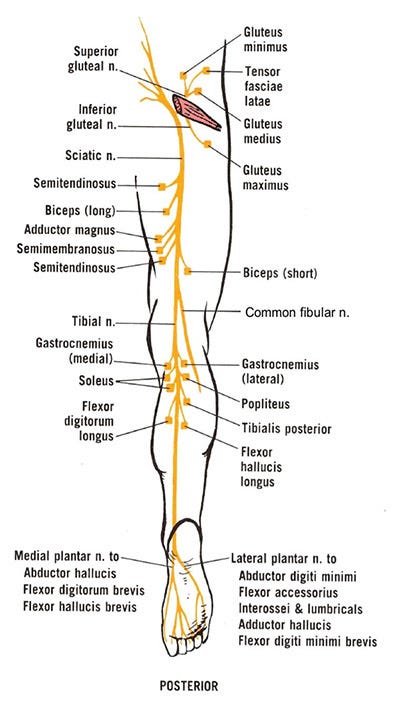
Could temporary impairment of the sciatic nerve influence hamstring, ACL, and Achilles tendon injury risk?
But while researching the sciatic nerve, I stumbled onto something so mind-blowing that it forced me to stop everything and rethink foundational assumptions in sports science. If true, it changes everything we understand about nerve–tendon relationships and non-contact injury risk.
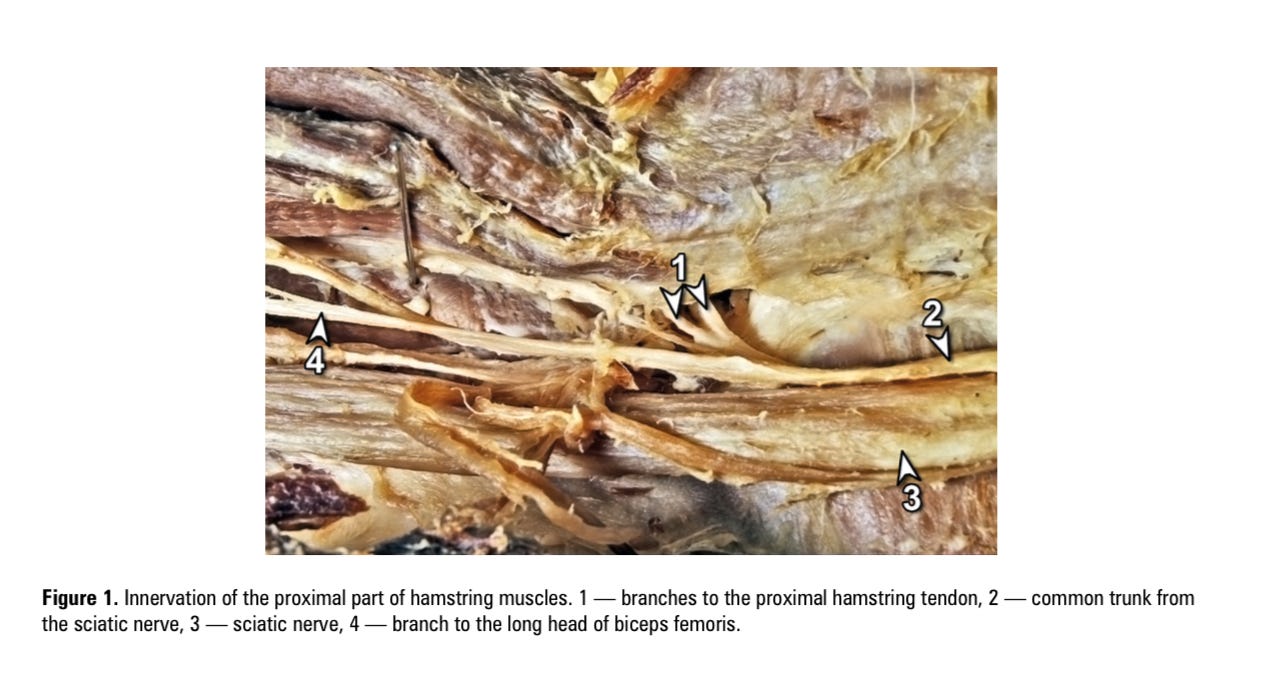
What I discovered in a 2024 anatomical study by Kozioł et al., published in Folia Morphologica, blew my mind: the proximal hamstring tendon has its own independent motor nerve branch. In 100% of the specimens examined, the proximal hamstring tendon received motor innervation. In 65% of cases, the first trunk off the tibial division innervated the tendon exclusively. In roughly 20%, the same trunk supplied both the tendon and the long head of the biceps femoris. And in the remaining specimens, the tendon was supplied by the second trunk. No matter the branching pattern, every single dissection demonstrated a motor branch directed specifically to the proximal hamstring tendon — meaning this independent tendon innervation is a consistent anatomical feature, not a rare anomaly.
This detail appears in only one published anatomical study that I could find. Nowhere else in sports science, physiotherapy, biomechanics, or performance literature is this independent nerve tendon innervation discussed. It is not taught in coaching education. It is not referenced in hamstring-injury models. Its implications have never been recognized. And as far as I can determine, I may be the first person to bring this discovery forward to the sports performance community.
Because this concept is so new — and because the field lacks a term to describe it — I am introducing Neurotendinous Function: the recognition that a tendon may possess independent motor innervation and therefore may function, in part, as a distinct neuromechanical structure.
But here is the critical point: we do not yet know how Neurotendinous Function behaves. There is zero published research (that I could find) on:
how the tendon’s motor branch fires
whether it activates before, after, or independently of the muscle
how it modulates stiffness
how it responds to fatigue
how it behaves under high-velocity traction
whether it can fail even when the muscle is fully functional
whether its neural timing contributes to non-contact injury mechanisms
The existence of the tendon’s motor supply is documented. Its physiology, behavior, and performance implications are completely unstudied.
Given that the proximal hamstring tendon is one of the most frequently injured tissues in elite sport, the absence of research into its neural control is staggering. If the tendon receives its own motor instructions, then the muscle–tendon unit cannot be assumed to function as a single synchronized system. The tendon and muscle may not fire together. They may not fatigue together. They may not protect one another under high load. And they may not fail for the same reasons.
This discovery raises profound and necessary questions.
Could impaired tendon-specific neural conduction contribute to sudden hamstring tears during terminal swing? Could proximal tendinopathy be partly neural rather than purely mechanical? Could delayed tendon activation increase ACL risk during deceleration or cutting? Could impaired tibial or common fibular branch conduction contribute to false-step Achilles ruptures? Does tendon neural fatigue occur before muscular fatigue? Are some athletes predisposed to injury based on their tendon-branch anatomy?
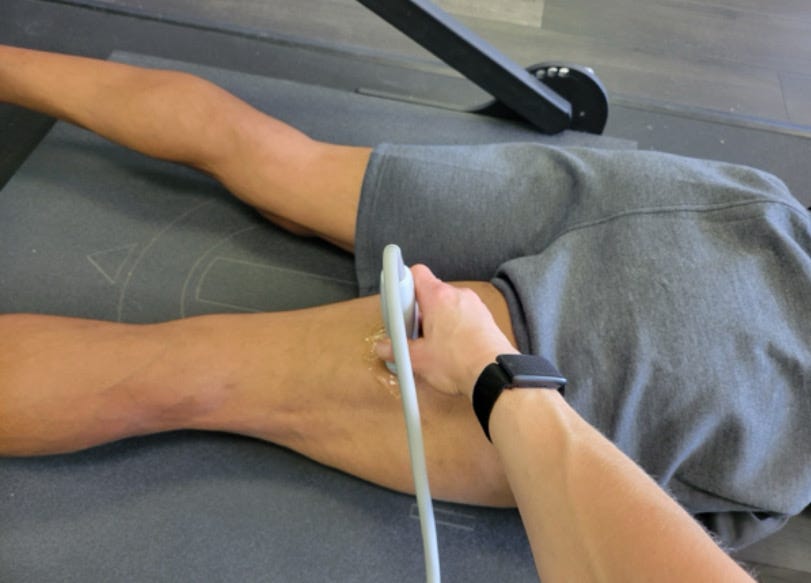
We do not know — because no one has ever studied these questions.
But if the tendon and muscle have independent motor innervation, then many of our long-held assumptions collapse. Muscle strength testing cannot predict tendon vulnerability. Eccentric strengthening alone cannot protect the tendon if neural timing is the true limiter. Traditional injury-prevention models must evolve beyond mechanical load and structural capacity. And our understanding of high-speed movement must now account for tendon-specific neuromuscular behavior.
This is not a small refinement. It is a paradigm shift.
Which leads to the most important point of all: we need research — urgently.
Sports science must now investigate:
how the tendon’s motor branch behaves during sprinting
whether its conduction can be impaired independently
how tendon-specific neural timing influences injury mechanics
how Neurotendinous Function interacts with fatigue
whether tendon neural delay precedes catastrophic failure
whether training can protect or enhance tendon-specific neural pathways
We are standing at the beginning of a new frontier in human performance.
The proximal hamstring tendon has its own motor nerve branch. It exists in 100% of tested specimens. It has never been studied. And if true, its implications for injury risk, performance, and rehabilitation are too significant to ignore.
Neurotendinous Function may prove to be one of the missing links in our understanding of non-contact injuries — or I could be 100% wrong. I am totally open to that. If there’s anyone doing unpublished research on this already please reach out. I’d love to connect.
At Isophit, we help the world’s strongest, fastest, and most dominant athletes—and everyday people—to win more, hurt less, and age stronger.
Learn more about Isophit at www.isophit.com