
Isometric Strength Linked to Better Curvilinear Running Performance

Coaches have traditionally prepared athletes for curved running through more sprinting, jumping, and dynamic resistance training. The assumption is understandable: because curvilinear running is dynamic, its physical preparation should also be predominantly dynamic.
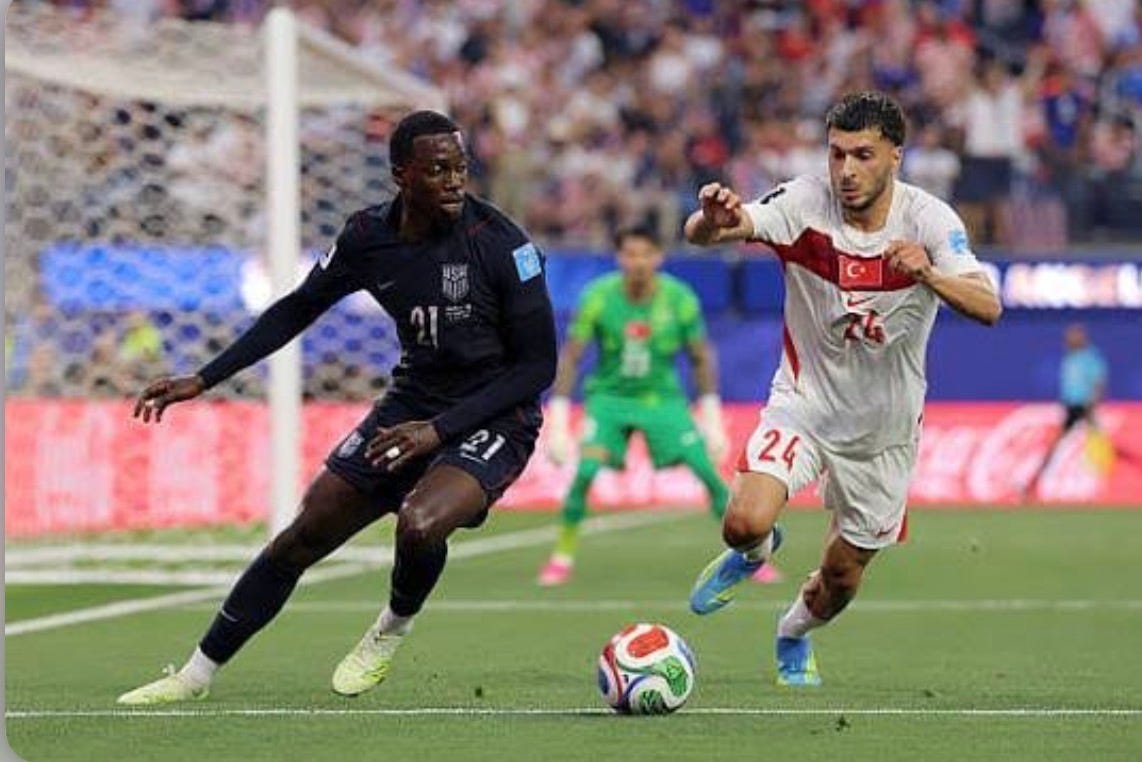
The emerging evidence suggests that assumption is incomplete. Athletes should directly practise curvilinear running and braking, but the force capacity supporting that skill appears to be deeply dependent on isometric strength.
A 2026 study published in The Knee helps explain the mechanical problem. Researchers compared straight-line and curved deceleration tasks performed at similar entry velocities. Resultant ground-reaction force did not differ significantly between conditions, yet curved braking produced a peak external knee abduction moment 76% greater than straight-line braking and 110% greater than a curved approach followed by straight braking.
The difference was leverage. During curved braking, the frontal-plane moment arm was 59% longer than during straight-line braking and 83% longer than during curved-to-straight braking. The ground-reaction-force vector acted farther from the knee-joint centre, increasing the external torque the athlete had to control.
The curve did not simply create more force. It made the existing force harder to manage.
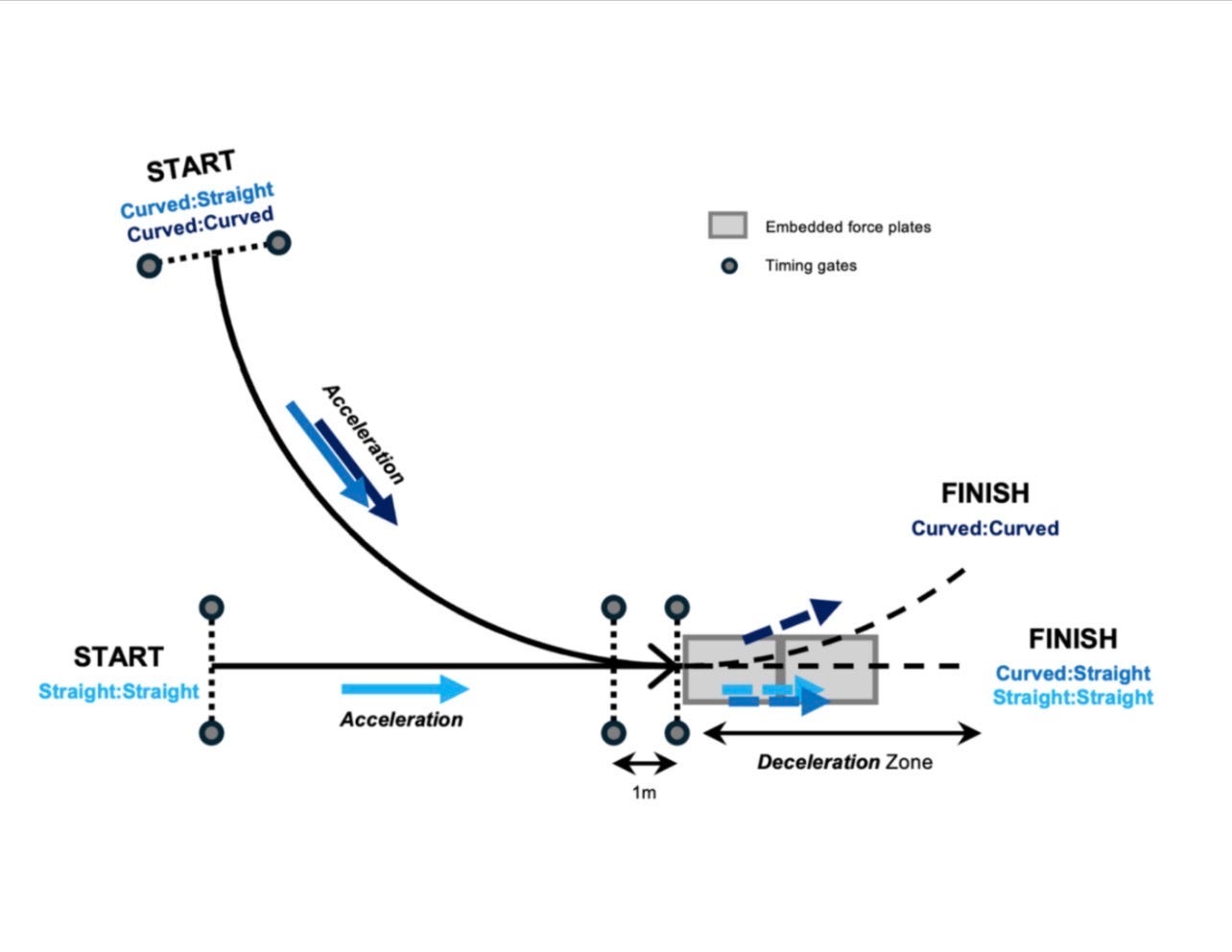
That control was required within the first 100 milliseconds after ground contact. The athlete cannot wait for movement to unfold before establishing joint control. Instantaneous isometric force must already be available as the foot contacts the ground and the external moment develops.
A second 2026 study involving 34 elite youth soccer players identified a physical quality associated with performing the curve more effectively. Greater isometric hip-abduction force was associated with faster curvilinear sprint times. Reactive strength was also related to performance, while countermovement-jump and drop-jump height were not significantly associated with curved sprint speed.
That distinction matters. Jumping higher did not clearly separate the faster curved runners. Greater isometric force production at the hip did.
The third study makes the training implication even harder to ignore. Researchers compared force production during an isometric leg press, countermovement jump, and squat jump. The isometric leg press produced 3,562 N of peak force, compared with 1,715 N during the countermovement jump and 1,670 N during the squat jump. Peak rate of force development reached 17,399 N/s during the isometric leg press, compared with 9,762 N/s and 9,544 N/s in the two jumping conditions.
The difference was especially important between 50 and 100 milliseconds. Isometric leg-press rate of force development reached 14,032 N/s, compared with 6,766 N/s during the countermovement jump and 7,235 N/s during the squat jump.
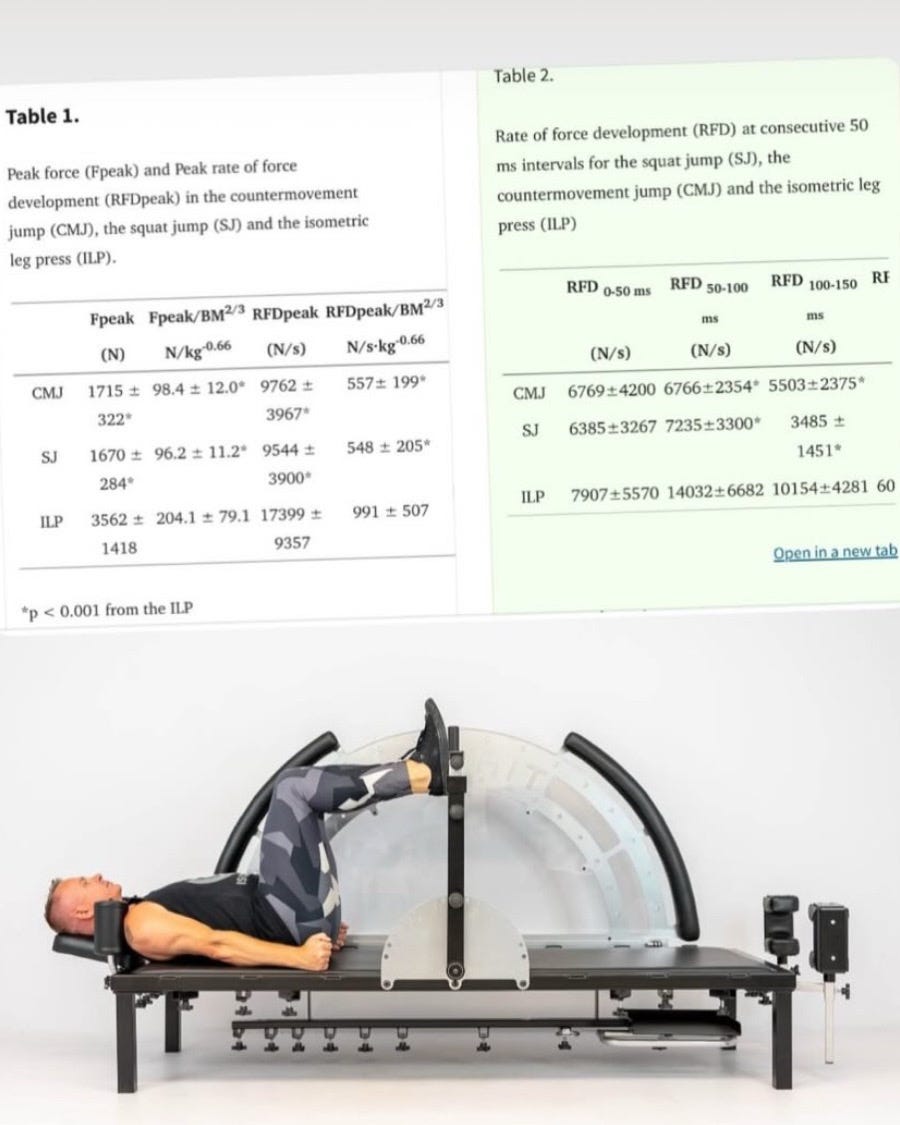
The three studies answer different questions, but their practical direction is remarkably consistent. Curved braking increases the leverage acting against the knee. Better curvilinear sprint performance is associated with greater isometric hip-abduction force. A multi-joint isometric action exposes substantially greater peak force and early force-development capacity than two common dynamic jump tests.
For the specific goal of improving curvilinear running and braking, jumping and conventional dynamic training are the less direct options. They may support general power, elasticity, and athletic development, but they should not remain the primary methods used to address a force demand that the evidence increasingly identifies as isometric.
The coaching hierarchy should be clear: practise the curve directly, then maximize the isometric force production required to control it.
That is a whole-body requirement. The foot and ankle interact with the ground. The knee manages frontal-plane loading. The hip and pelvis regulate lateral force and rotation. The trunk controls lean and upper-body inertia. The cervical musculature regulates the head while the eyes gather information, the brain interprets the environment, and the central nervous system coordinates the response.
Fatigue raises the importance of this capacity. Curved sprints, defensive recoveries, and braking actions are repeated throughout competition. The demands of the game do not decrease simply because the athlete’s instantaneous, peak, or sustained isometric force production has begun to decline.
Sports science continues to discuss isometric strength, yet most teams barely train it. Occasional rehabilitation exercises or a few brief contractions do not constitute a whole-body isometric strength program. Teams should be running dedicated isometric strength training camps and allocating enough equipment to train the roster together.
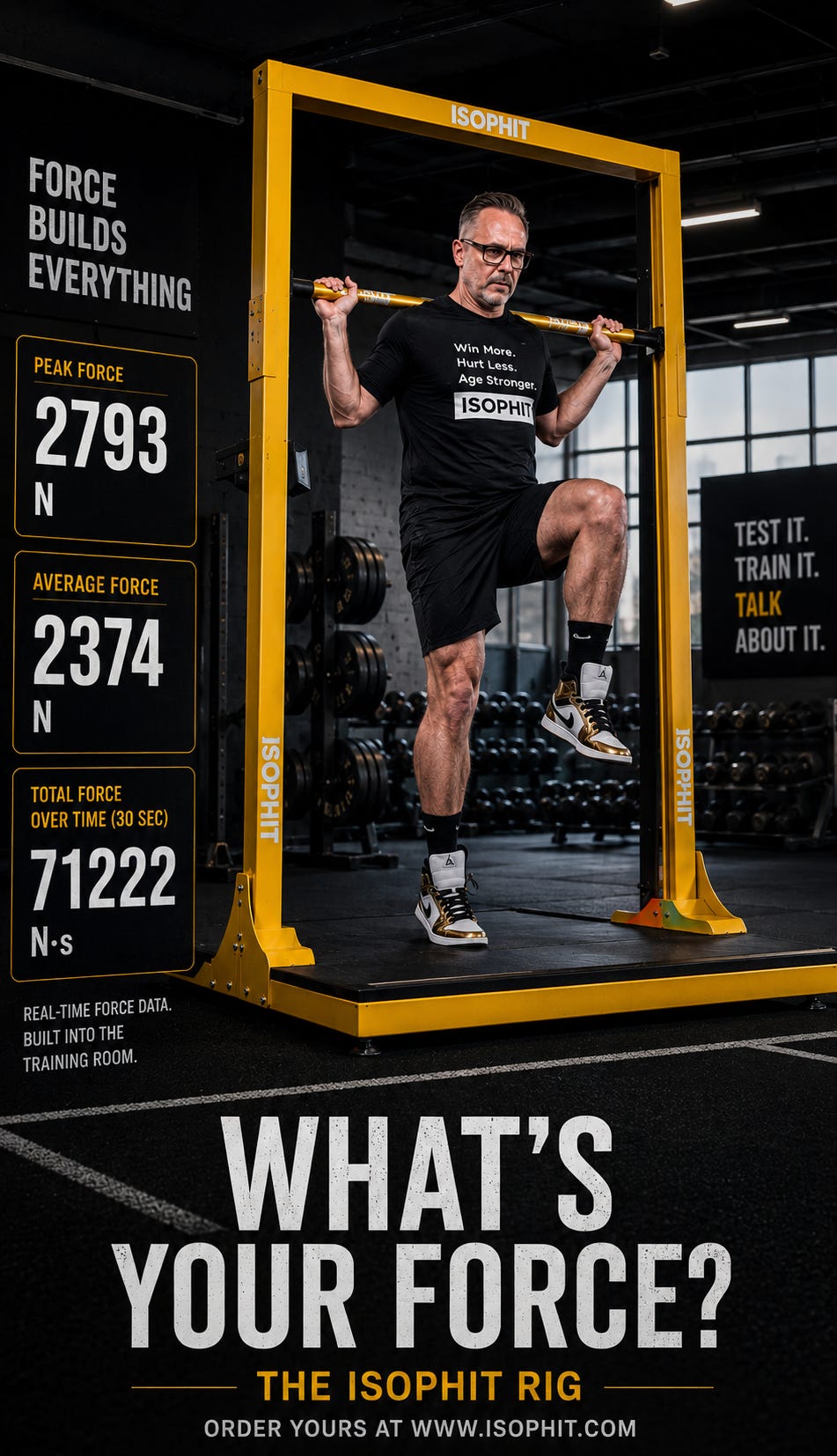
The Isophit Rig gives coaches a simple way to test. Its platform functions like a giant scale and displays force at 100 milliseconds, peak isometric force, average force, and Total Force Over Time. Enough Isophit Strength Kits then allow teams to move beyond testing and systematically develop whole-body isometric strength at scale.
Curvilinear practice develops the skill. Isometric training develops the force capacity required to express and protect that skill. Teams relying primarily on jumping and dynamic training for this specific task are training around the demand instead of directly addressing it.
At Isophit, we help the world’s strongest, fastest, and most dominant athletes—and everyday people—win more, hurt less, and age stronger.
Learn more at www.isophit.com.
Knowledge only creates value when it is shared. If this article changed how you think about the topic, consider sharing it with a coach, athlete, clinician, colleague, friend, or family member.

References
Galmiche, L., Kersting, U. G., & Bill, K. (2026). Curved decelerations result in greater frontal-plane knee loading than straight-line tasks. The Knee, 62, 104534.
Ribič, A., & Sašek, M. (2026). Relationship between curvilinear sprint performance, hip strength, jump performance and reactive strength in elite youth soccer players. Scientific Journal of Sport and Performance, 5(2), 269–279.
Evaluation of the Isometric and Dynamic Rates of Force Development in Multi-Joint Muscle Actions. (2022).