Does Dynamic Training Leave Athletes Weaker Than Isometric Training?

VALD’s Instagram post yesterday got me thinking. For decades, the strength and conditioning industry has operated under a deeply ingrained assumption: dynamic movement is the ultimate expression of athletic force production.
It sounds logical. Sport is dynamic. Sprinting is dynamic. Jumping is dynamic. Cutting, skating, tackling, and striking are all dynamic. Therefore, the belief became almost unquestioned: the best way to develop force must also be dynamic.
But what if one of the foundational assumptions of modern training is wrong?
What if movement complexity itself is often the factor limiting maximal force expression?
That question has enormous implications for sports performance because force production is not merely about movement. It is about how much tension the nervous system can generate, sustain, organize, and direct into the environment.
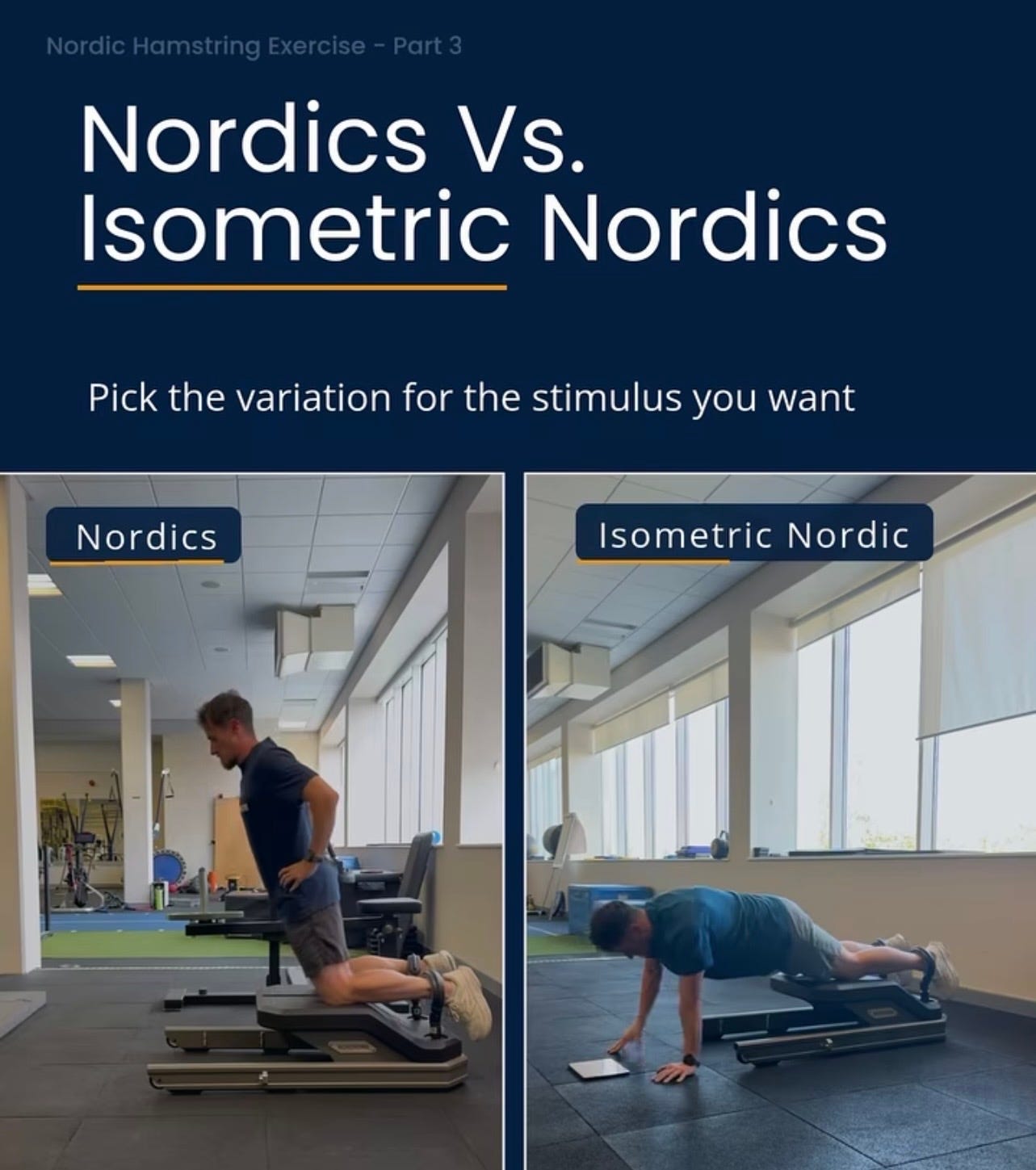
That is why VALD’s recent comparison between Nordic hamstring repetitions and isometric holds was so interesting. The findings showed the isometric condition accumulated more total time above 80%, 85%, and 90% of maximum force. In simple terms, the athletes spent more time producing extremely high levels of force during the isometric condition than during the dynamic movement condition.
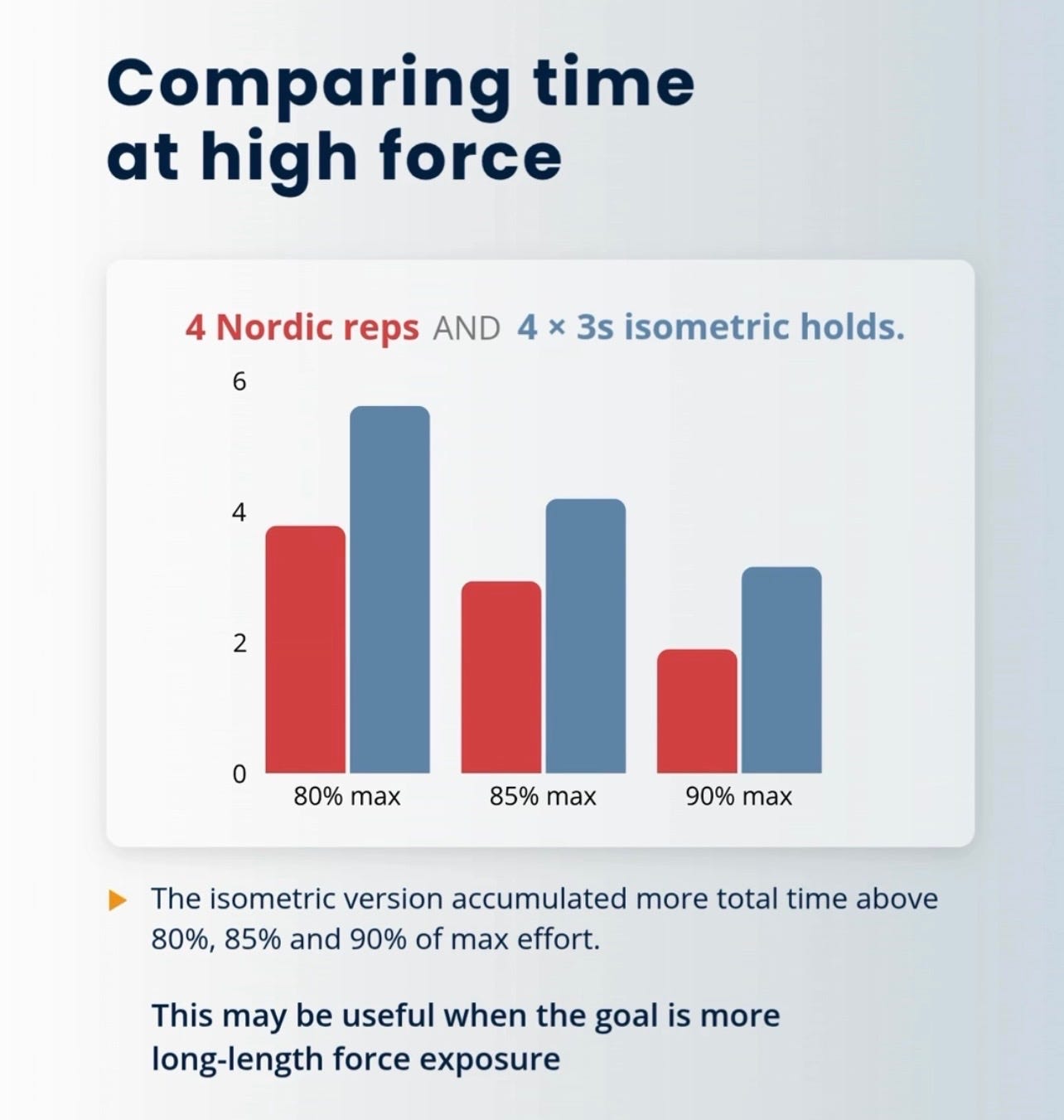
That finding cuts directly against conventional thinking.
Adaptation is not determined solely by movement. Adaptation is determined by exposure to tension — specifically the magnitude, duration, and quality of force experienced by the neuromuscular system. And this is where the traditional narrative surrounding dynamic and eccentric exercise begins to fracture.
Yes, eccentric contractions are capable of producing very high forces. That is physiologically true. But theoretical force potential and practical high-force exposure during training are not the same thing. Once movement enters the equation, force production must compete against balance demands, shifting leverage, coordination requirements, velocity fluctuations, technical execution, and energy leakage throughout the kinetic chain.
Movement complexity often becomes the factor limiting maximal force exposure.
The body is no longer directing all available resources toward force production. Neural resources must also be allocated toward stabilization, coordination, posture, timing, and movement management. That distinction changes everything.
The sports performance industry has traditionally viewed movement as proof of superior athletic loading. But the emerging evidence suggests the nervous system may actually express its highest force-producing capabilities when movement is constrained enough to reduce interference.
Ironically, the evidence supporting this idea is not new.
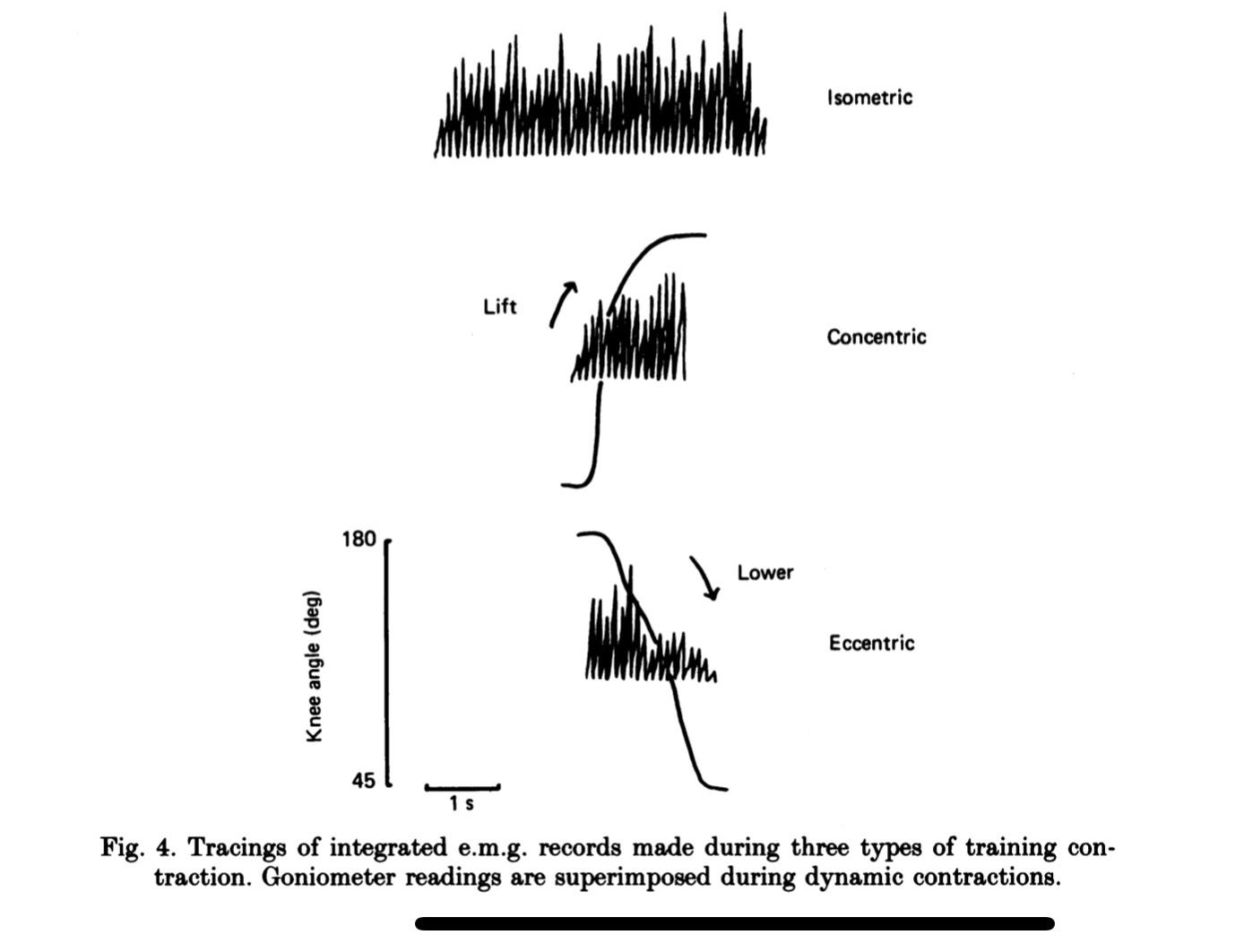
In 1987, Jones et al. published a landmark study comparing isometric, concentric, and eccentric quadriceps training. The findings should have fundamentally altered strength training discussions for decades to come.
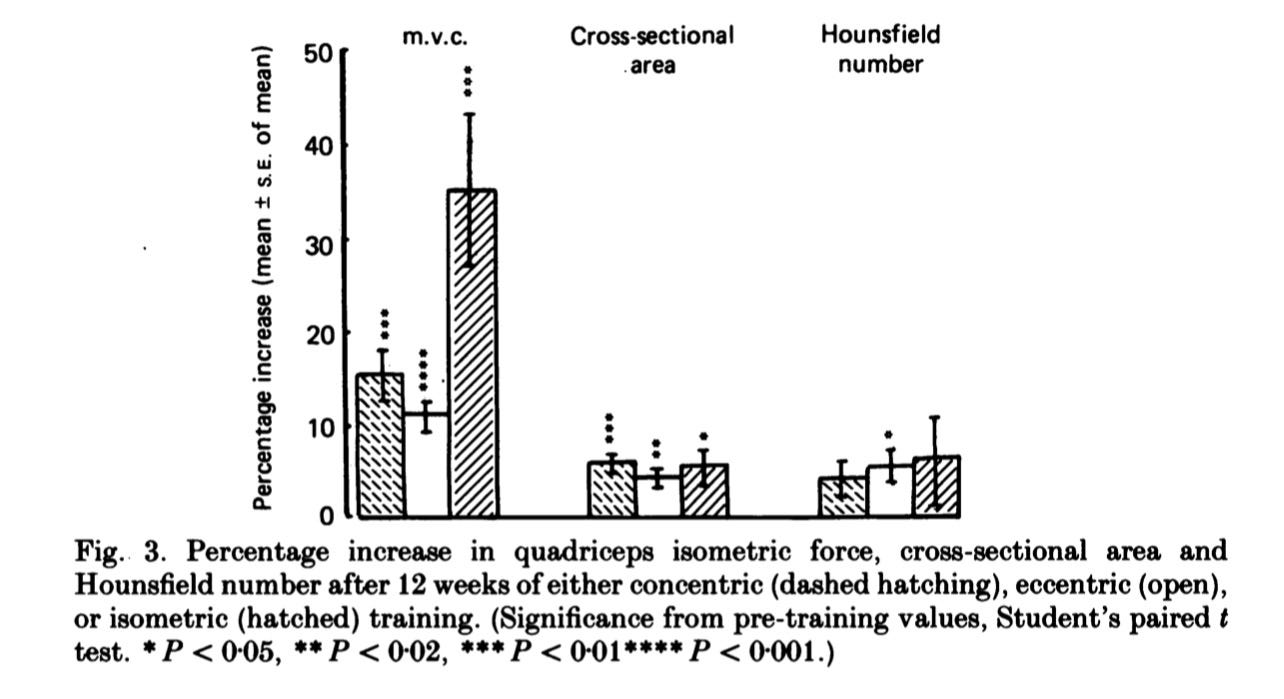
Isometric training increased strength by approximately 35%. Eccentric training improved strength by only 11%, while concentric training improved strength by approximately 15%. Even more remarkable, the eccentric training condition used roughly 45% greater loading than the concentric condition — yet still failed to produce superior strength gains. The researchers also reported that total integrated EMG activity during the isometric contractions was approximately twice that of the dynamic conditions.
Think about what that means.
The supposedly “less athletic” contraction mode produced substantially greater sustained muscular activation despite less movement, less velocity, and less mechanical complexity. Once again, movement appeared to reduce high-force exposure rather than enhance it.
More recent research has only intensified this debate.
Maffiuletti et al. reported that peak rate of force development — one of the most prized qualities in sports performance — was heavily influenced by maximal voluntary force production. In other words, maximal isometric force appears to be one of the major physiological foundations underlying explosiveness itself.
That finding creates a major problem for traditional training assumptions.
For years the industry has treated “explosive” training and maximal force training as though they are separate qualities. Athletes are often taught to chase movement speed before first maximizing the total force available to express.
But rapidly expressing force is not the same thing as possessing force.
You cannot rapidly express force that does not at least partially exist in the first place.
Martinopoulou et al. compared isometric leg press performance against countermovement jumps and squat jumps and revealed something equally important. The isometric leg press produced peak force values of approximately 3,562 newtons. The countermovement jump produced approximately 1,715 newtons, while the squat jump produced approximately 1,670 newtons.
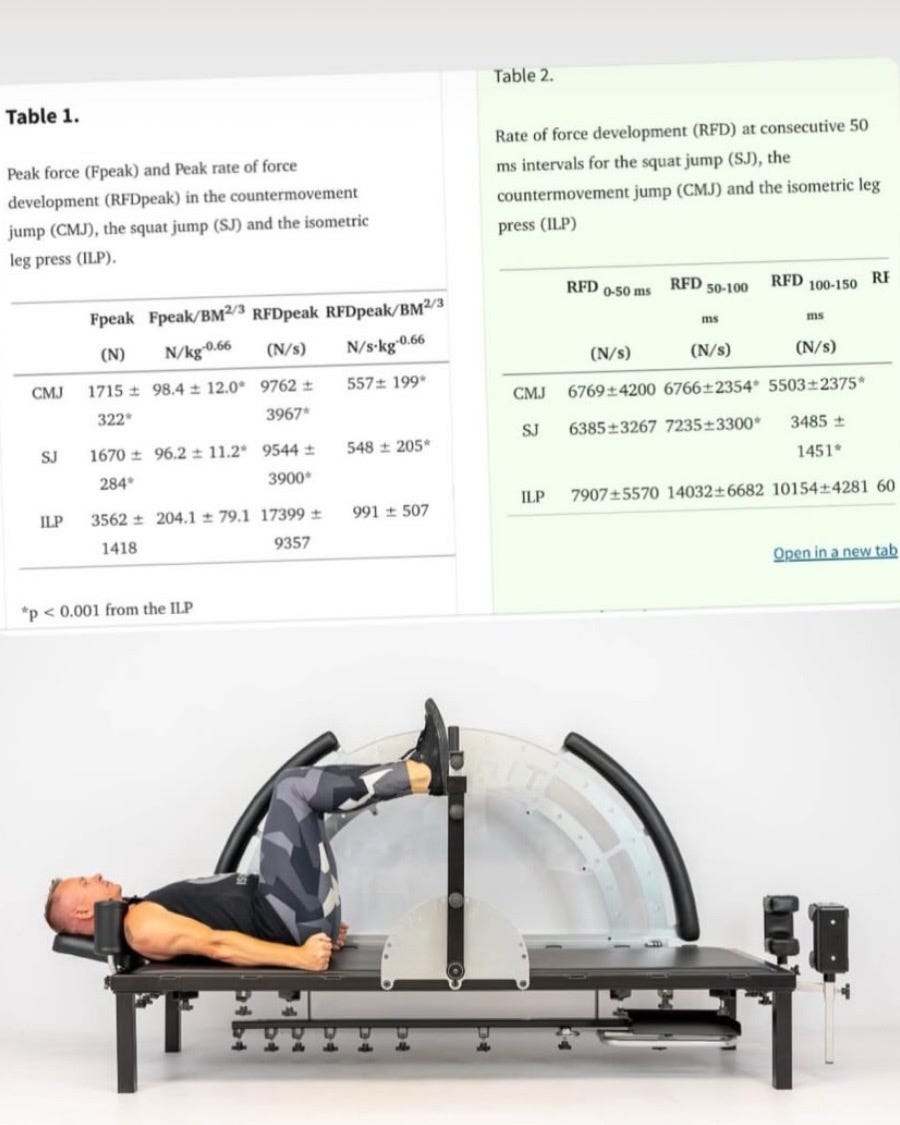
The differences in rate of force development were equally dramatic. The isometric leg press generated peak rates of force development of roughly 17,399 newtons per second, compared to approximately 9,762 newtons per second during the countermovement jump and 9,544 newtons per second during the squat jump.
These were not marginal differences.
Although the tasks differed mechanically, the constrained isometric environment allowed dramatically greater force and rate of force development expression. That means the highest-force environment available to the nervous system may not always occur during movement itself. It may occur when movement is constrained enough for force to fully organize and express itself against resistance.
This may explain why many of the highest-force moments in sport occur during brief periods of near-zero or zero joint velocity. Ground contact. Planting. Bracing. Blocking. Decelerating. Stabilizing. These moments are dominated by the body’s ability to create and tolerate enormous isometric tension while controlling motion around it.
Elite movement may ultimately depend upon elite isometric force production.
This does not mean dynamic training lacks value. Sport absolutely requires movement skill, coordination, rhythm, timing, elasticity, and technical execution. Athletes must sprint, cut, jump, rotate, strike, react, and adapt dynamically.
But movement skill and maximal force production are not identical physiological goals.
The nervous system appears to understand this instinctively. As instability and movement complexity increase, the body often reduces force output to preserve coordination and joint integrity. Isometric environments remove much of that interference, allowing athletes to direct intent into restraint without continuously reallocating neural resources toward balance correction and positional adjustment.
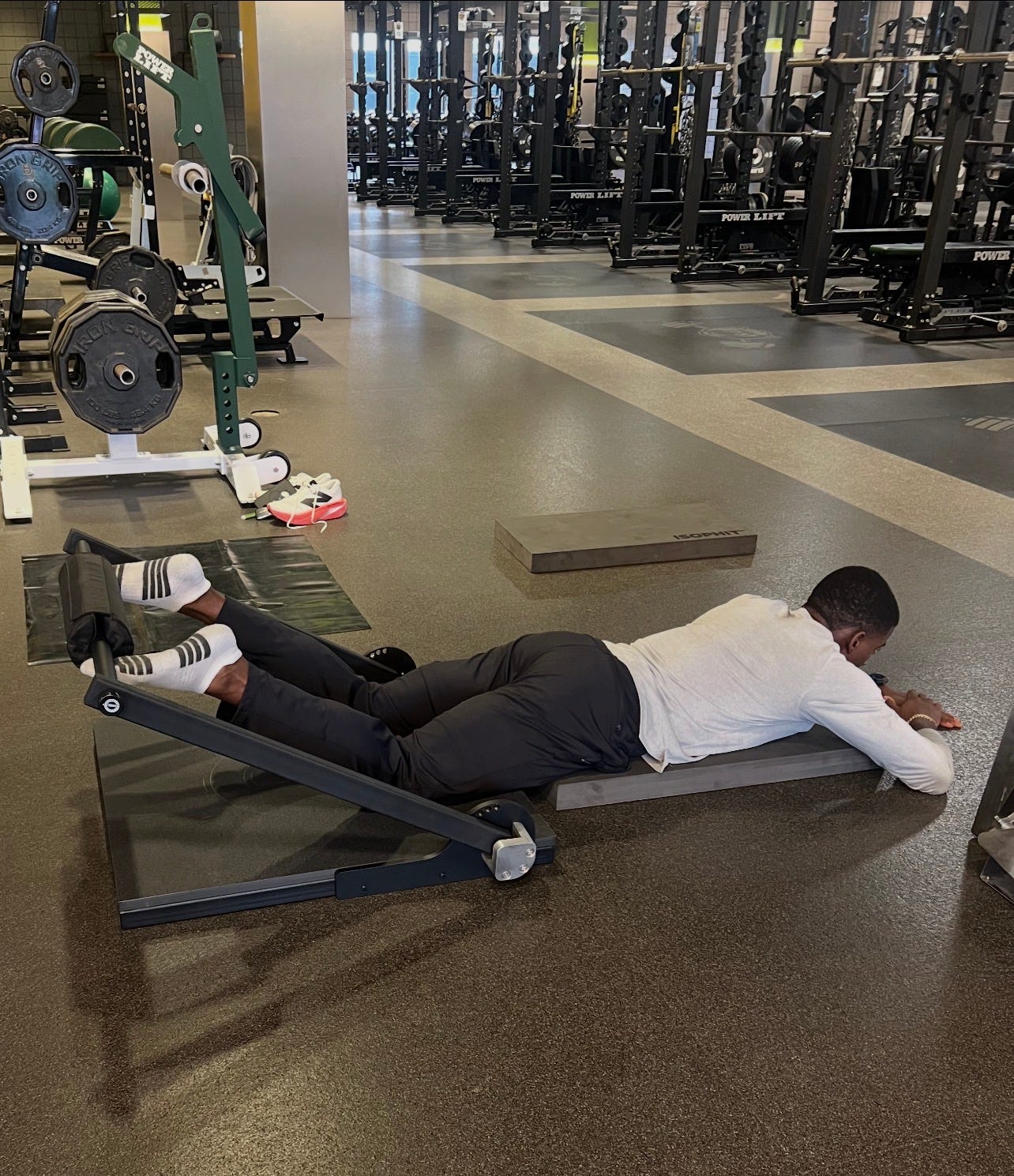
The result is often greater force concentration, greater sustained tension, and greater access to the nervous system’s true force-producing capabilities.
That may be the uncomfortable realization modern performance culture is beginning to confront.
The industry spent decades assuming movement was proof of superior force production, while the emerging evidence suggests movement complexity may often reduce maximal force expression rather than enhance it.
If that is true, then isometric strength training is not supplemental training. It may be one of the foundational force-development methods modern athletes have been missing all along.
At Isophit, we help the world’s strongest, fastest, and most dominant athletes—and everyday people—to win more, hurt less, and age stronger.
Learn more at www.isophit.com